
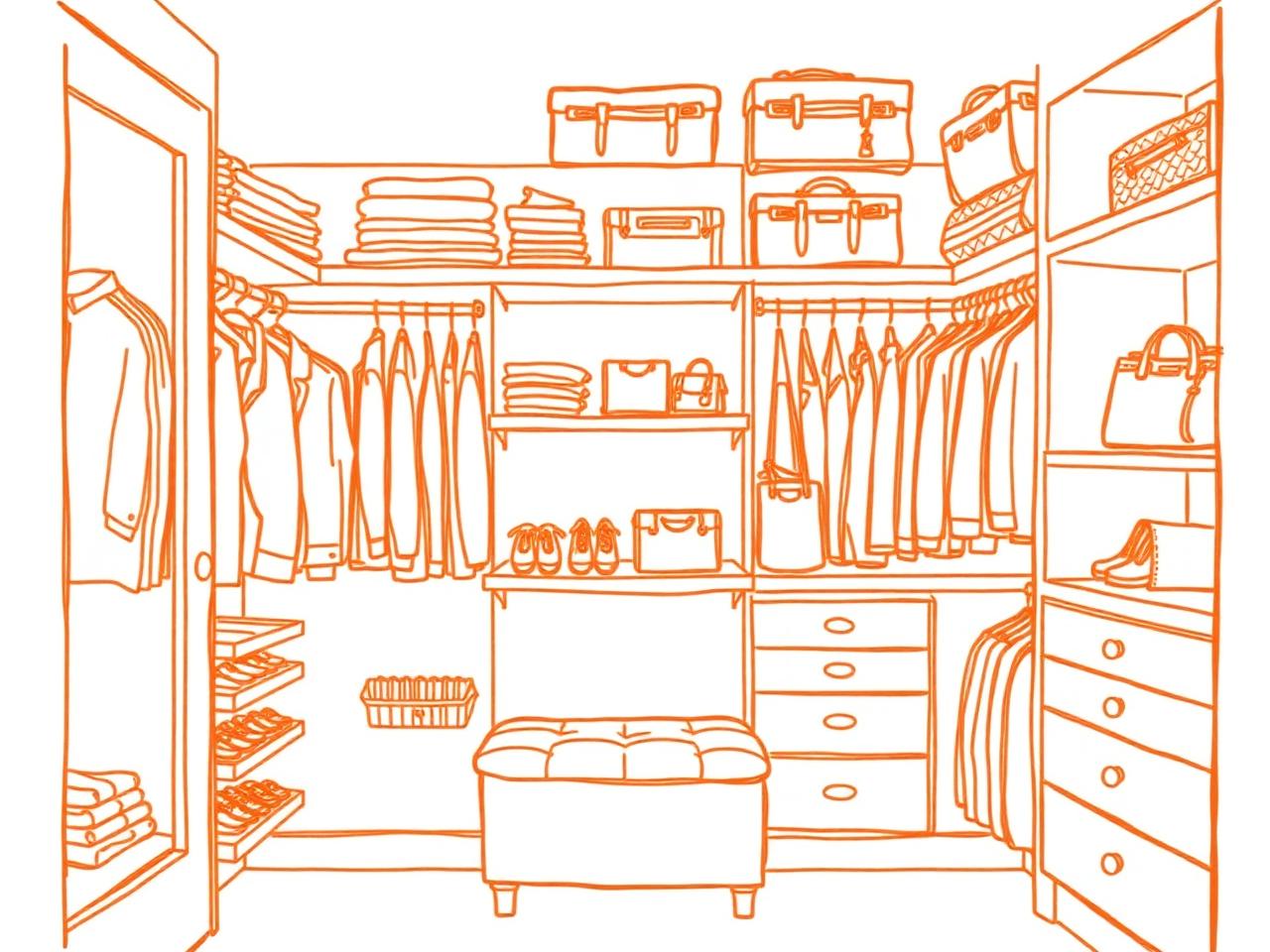
The best storage designers know something that most people don't. Organizing isn't really about shelves — it's about behavior.
A beautifully designed closet that doesn't match the way someone lives will slowly become messy again. A modest closet designed around daily habits can stay organized for years.
"Design for the person first. Storage second."
After designing thousands of storage spaces, I've found that every successful project follows the same quiet process.
Step 1: Observe before you design
Most people start with measurements. I start with questions.
- What do you wear every day?
- What never gets used?
- Which drawer is always overflowing?
- Do you fold sweaters or hang everything?
- Are you right- or left-handed?
- Do you get dressed quickly, or enjoy taking your time?
The answers determine the layout far more than the room dimensions do. An organized space should reduce decisions, not create more.
Step 2: Measure the things — not just the room
Professionals often memorize room dimensions. Great designers memorize the dimensions of what goes inside. A few practical references I keep close:
- Men's dress shirt — 30–32" hanging height
- Women's blouse — 24–26"
- Long dress — 58–65"
- Jackets — 40–44"
- Folded sweaters — 10–12" deep
- Folded jeans — 12–14" deep
- Handbags — 12–16" wide
- Boots — 18–24" high
Step 3: Think in pairs, not inches
One of my favorite examples involves shoes. Many closets waste enormous space because shelves are built to arbitrary widths. Instead, design around how shoes actually fit.
Men's shoes typically measure about 9–10 inches long. A 24-inch shelf comfortably holds three pairs of women's shoes — but only two-and-a-half pairs of men's. If your client owns mostly men's shoes, why build every shelf at 24 inches? An 18-inch section may do more work. Alternating widths often wastes the least space of all.
Tiny decisions multiply.
Step 4: Every vertical inch has a job
Most closets waste height. People stop designing at the point they can comfortably reach. Professionals know better.
- High shelves — luggage, seasonal clothing, holiday decorations, keepsake boxes
- Shoulder to waist — the things you touch every day
- Highest and lowest — the things you touch a few times a year
Good storage is simply good ergonomics.
Step 5: Stop copying Pinterest
One of the biggest mistakes homeowners make is trying to recreate someone else's closet. Beautiful isn't always practical. Someone with forty handbags needs a different solution than someone who owns twelve fishing rods. Storage should reflect a life, not a trend.
Think outside the box
Sometimes the best solution isn't the one the client originally imagined.
No room for an island? Try a peninsula. A peninsula gives you almost the same folding surface, adds drawers, requires less walking clearance, and costs less cabinetry. Often it's simply the better design.
Skip the island altogether
Ask yourself: does the room really need another cabinet? A storage ottoman can offer seating, hidden storage, flexibility, and easier movement — especially in a smaller closet.
Corners are valuable real estate
Corners often become dead space. They shouldn't be.
- Pull-out accessory racks
- Rotating shelves
- Angled shoe displays
- Corner hampers
Every corner deserves a purpose.
Design for habits
Think about the morning. If someone wears jeans every day, jeans belong near the shirts — not across the room. If someone kicks off shoes at the front door, shoe storage may belong at the entry rather than inside the closet at all. Organization follows behavior.
The hidden psychology
Clutter creates visual noise. Visual noise increases stress. Every unnecessary decision consumes a little mental energy.
When every item has an obvious home, mornings become easier, cleaning becomes faster, and people feel calmer. Good storage doesn't just organize belongings — it organizes attention.
A professional checklist
Before I finalize any design, I run through the same short list:
- Is every inch serving a purpose?
- Does the storage match the client's daily habits?
- Is the most-used storage between waist and eye level?
- Are shelves sized for the actual items?
- Is hanging space appropriate for the clothing?
- Could a peninsula outperform an island?
- Could furniture provide hidden storage?
- Have I designed for today's lifestyle instead of a magazine photo?
If the answer is yes, you're no longer designing cabinetry. You're designing how someone experiences their home every single day.
"People rarely say they love a closet because it has beautiful shelves. They love it because, every morning, life feels just a little easier. That is what great design is really about."